
Vacant Property Demolition
When property owners fail to maintain their homes, time takes its toll. Eventually, a property may become so deteriorated that the only remaining, economically feasible option is to demolish it to protect public health and safety.
Over the past few decades, cities grappling with widespread vacancy have spent hundreds of millions of dollars on demolition. Following the 2008 recession, federal programs like the Hardest Hit Fund—which provided $7.6 billion initially in 2010 and an additional $2 billion in 2016—helped communities acquire and demolish distressed properties at scale. While these efforts successfully removed dangerous “blighted” properties, vacant properties in many communities continued to rise. After all, demolition cannot address the underlying weak real estate market, nor incentivize new residents to move in.
Large-scale demolition created a new, long-term challenge for communities: what to do about all the vacant land. Vacant land now makes up 85 percent of land bank vacant property inventories, much of it scattered across residential neighborhoods as individual vacant lots—a pattern that makes finding new, appropriate uses for them extremely difficult. Rebuilding single-family homes lot by lot, for instance, makes little sense in a city that has lost 40 percent of its population.
Demolition alone cannot solve a community’s “blight” problem. To be effective, demolition must function as a strategic tool within a broader equitable revitalization strategy, otherwise, the pipeline of properties needing demolition will never stop growing. This section outlines the key questions communities should consider as they develop a demolition strategy.
When is Demolishing a Vacant Property Necessary?
Deciding to demolish a building—particularly one with historical, cultural, or architectural significance—is rarely easy or uncontroversial. But in many situations, demolition is unavoidable due to the building’s condition, the cost of rehabilitation, and the lack of willing parties with the resources to rehabilitate it.

Demolition is a process that, when carried out properly, leads to the removal of a building in a way that protects the health of neighbors and contractors, ensures materials are disposed of responsibly, and leaves the site ready for appropriate future reuse. The Demolition Elements Table below outlines the key steps in this process.
It’s worth noting that “demolition” encompasses several distinct approaches. The most common method uses heavy machinery to raze a structure and send all materials to a landfill. Increasingly, however, municipalities and states require contractors to recycle demolition materials. Still, a growing number have embraced deconstruction—the careful salvage of materials for reuse, either by contractors or nonprofit organizations. Deconstruction can offer meaningful environmental and economic benefits, though it requires a viable local market for salvaged materials. Methods range from targeted removal of high-value architectural items to fully disassembling a structure by hand, with costs, timelines, and environmental benefits varying accordingly.
To learn more about deconstruction and its benefits, see these resources:
- Delta Institute’s Deconstruction & Building Material Reuse: A Tool For Local Governments & Economic Development Practitioners
- Build Reuse
- Michigan State University’s Center for Community And Economic Development, Domicology
- EPA Residential Demolition Recycling Resources and Deconstruction Rapid Assessment Tool
Table: Elements and Responsible Parties in Vacant Property Demolition
| Element | Responsibility | Description |
|---|---|---|
| Bidding and contracting | Municipality | Preparation and distribution of bid documents and specifications, selection of firm and execution of contracts |
| Permitting | Contractor | Obtain required demolition permits, cut and fill, street/sidewalk blocking permits, fire hydrant (for wetting debris) permit and other approvals |
| Asbestos survey | Consultant | Survey to determine presence and composition of asbestos in building |
| Setup | Contractor | Onsite preparation for demolition |
| Removal of asbestos | Contractor | Asbestos removal and disposal (may be done by a separate contractor) |
| Demolition | Contractor | Demolition of structure(s) on the property |
| Removal of materials | Contractor | Depending on circumstances, materials may be taken to a landfill, recycled, or reused through deconstruction |
| Removal of foundations | Contractor | Removal of below-grade foundations |
| Restoration of party walls | Contractor | Where building shares a common wall with another building, the wall must be restored after demolition to prevent damage to the adjacent building |
| Site finishing | Contractor | Filling of below-grade areas with clean fill, grading, seeding, and other treatment to the site |
| Supervision, indemnification, and complaint management | Municipality | Monitoring of work and ensuring that contractor complies with all legal and public health requirements |
Source: Adapted from Alan Mallach, Laying the Groundwork for Change (Brookings Institution, 2012), 17.
Vacant property demolition may be necessary when…
1. The supply of buildings exceeds demand.
In communities experiencing long-term population and job loss, the supply of properties can far outpace demand—creating a structural imbalance that may justify large-scale demolition. Market demand in cities like Detroit, Cleveland, and Baltimore has not been sufficient to keep the existing housing stock in productive use, and even as demolition has reduced supply, demand has continued to fall. The scale of this trend is striking: between 1960 and 2000, Detroit removed 178,000 dwelling units—32 percent of its 1960 housing stock—while vacancy continued to rise. The problem accelerated in the early 2000s, when mortgage and tax foreclosures pushed even more properties into abandonment on top of already declining demand.
2. The costs on a community from vacancy and abandonment are high.
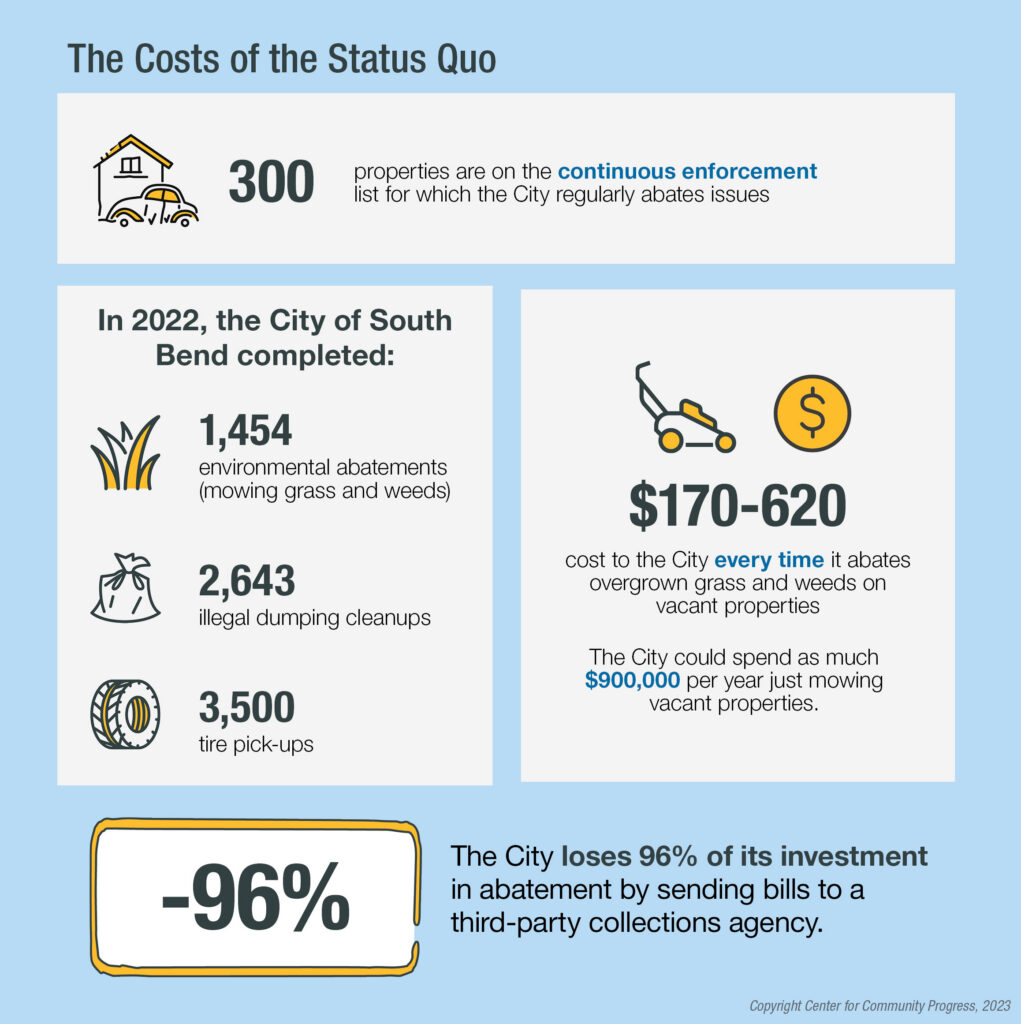
Vacant and abandoned buildings impose significant social and economic costs on municipalities and residents alike. Maintaining these properties is expensive, and the loss of tax revenue—both from the properties themselves and from the depressed values of surrounding homes—creates a serious fiscal drain on local government.
The human costs are arguably more significant. Abandoned buildings undermine neighborhood vitality, public health, quality of life, discourage reinvestment, and raise a fundamental question of social justice: Why should lower-income residents bear the burden—diminished home values, compromised safety, weakened neighborhoods—of circumstances entirely outside their control? It’s no surprise that abandoned buildings consistently rank among the top concerns of residents in lower-income neighborhoods.
3. A community needs to mitigate the impacts of abandonment.
While vacant lots are far from ideal, the evidence suggests they are meaningfully less harmful than vacant buildings. Compared to deteriorated structures, vacant lots pose fewer risks of criminal activity and fire, cost less for cities, neighboring property owners, and volunteers to manage, and are far more amenable to productive reuse.
- In Flint, Michigan and Philadelphia, Pennsylvania, researchers found that residents living in neighborhoods with better maintained vacant lots reported better mental health and less fear than residents in areas with poorly maintained lots.
- In Saginaw, Michigan, the land bank partnered with Saginaw Basin Land Conservancy to seed 1,500 lots with a native, pollinator-friendly seed mix to improve environmental conditions of lots and reduce maintenance needs.
- Crime density and severity declined around vacant lots owned and stewarded by a land bank, found a 2023 study in Flint.
- In Detroit and Milwaukee, community gardens on formerly vacant lots were associated with higher fruit and vegetable consumption because gardeners felt more connected to the food they grew. Community gardeners also reported a greater sense of neighborhood connection.
- In Youngstown, Ohio, streets near professionally mowed vacant lots saw deeper declines in violent crime than streets near unmowed vacant lots. Vacant lots repurposed by community groups were associated with even greater declines in crime in the surrounding neighborhoods.
Unlike vacant buildings, which typically require full rehabilitation to be reused, vacant lots open up a range of lower-cost and creative options: sale to adjacent homeowners as side lots, community gardens, play areas, or restored natural spaces that help manage stormwater.
LEARN MORE
See examples of vacant land reuse—and submit your own!—in our vacant land project database.