
Tools and Strategies to Address Vacant Properties
IN THIS SECTION
Armed with a clear picture where your vacant, abandoned, and deteriorated properties are located, what condition they’re in, and who owns them, a community is well-positioned to develop a comprehensive strategy for neighborhood revitalization.
This page gives an overview of the tools and strategies for addressing vacancy. Each represents an intervention on the continuum of addressing vacant and abandoned properties, from preventing a property from deteriorating past the point of no return, to legal mechanisms that transfer control when owners walk away. A community’s strategy should make sure that all these tools are set up to work together. Understanding how they relate to one another is key to deploying them effectively.
Most tools to address problem properties operate on one basic premise: An owner—even if their property is vacant and deteriorated—would rather improve their property themselves rather than risk having the city do it and bill them for the cost, or risk losing their property altogether.
Your local and state law determines which tools and strategies are available for your community to use. The following overview is for informational purposes only. Communities should consult with appropriate legal counsel before pursuing any specific approach.
GET HELP
Community Progress can help. We have supported over 300 communities across the United States with customized, expert technical assistance to tackle property revitalization. Contact us to learn more.
Code Enforcement
To the extent allowed by state law, local governments can enforce codes dealing with property maintenance, health, and safety against both occupied and vacant properties.
Traditionally, most local governments rely on complaints to identify violations, and use fines and criminal penalties to enforce local property maintenance ordinances. This approach may work in stable or strong real estate markets and when owners have the resources to make repairs—but in weak markets, this approach is often inequitable, inefficient, and ineffective.
- A more effective approach focuses on achieving compliance rather than simply punishing violations.
- Under a strategic code compliance approach, local governments would:
- Treat code enforcement as a core neighborhood stabilization tool that protects community health and safety
- Adequately fund code compliance efforts
- Embed partnerships and collaboration in code compliance efforts
- Align the municipality’s human resources policies, practices, and work culture with this new framework
To shift to such an approach, local governments should:
- Use parcel, market, and social data to drive proactive decision-making and resource allocation
- Treat different types of properties and owners differently
- Track and evaluate outcomes and adjust as needed—with a commitment to transparency and communication
- Break out of silos to work with other departments and sectors
- Support an internal culture focused on compliance
- Make equity both a core principle and a desired outcome
A key element of strategic code compliance is developing different strategies for different property types—vacant properties, rental housing, and owner-occupied housing.
LEARN MORE
To learn more about strategic code enforcement and how to shift to a more compliance-based approach, download Reevaluating Code Enforcement.
Owners have different incentives and abilities to bring their properties into compliance, based on type of owner, type of property, and location of the property. A violation notice sent to an accessible homeowner, with resources, in a strong market may result in compliance. The same notice sent to an out-of-state LLC owning a vacant property in a weak market neighborhood is likely to go ignored.
Applying the same enforcement strategy across the board wastes limited resources and fails to achieve results. Local governments should instead develop tailored strategies for each common problem property type, accounting for owners’ varying incentives and abilities to comply.
Code Enforcement Strategies for Vacant Properties
A strategic code compliance approach to vacant properties focuses on three goals: 1) quickly reducing the harms these properties cause, 2) recouping public expenses incurred to maintain them, and, where necessary, 3) compelling their transfer to new, more responsible ownership. This approach can be summarized as: “Fix it Up, Pay it Up, Give it Up”:

Fix it Up means giving owners notice of the violation and a clear opportunity to achieve compliance. In some cases, it may be appropriate to provide a willing but resource-limited owner with the support needed to make repairs.
Pay it Up means that if an owner is unresponsive or unwilling to fix the property, the local government steps in to reduce the harm. This may include securing, maintaining, or demolishing the property—with a priority lien placed against it for the full cost of those activities.
Give it Up means, as a last resort, if the owner refuses to reimburse the public costs incurred, the local government takes action to compel transfer of the vacant property to new ownership, which may include temporary public stewardship. The legal mechanisms available (such as receivership, abandonment procedures, property tax foreclosure, and code lien foreclosure) vary by state. In weak real estate markets, well-designed tax or priority lien foreclosure systems tend to be the most equitable, efficient, and effective path to transfer.
Local governments should also develop specific strategies to address three common vacant property types: heirs’ properties, “zombie” and bank-owned properties, and commercial properties.
LEARN MORE
To learn more about strategic code enforcement and how to shift to a more compliance-based approach, download Reevaluating Code Enforcement.
Delinquent Property Tax Enforcement
Property tax delinquency is an early warning sign of a property’s decline. Vacant properties, whose owners have walked away from responsibilities like basic upkeep of the property and paying property taxes, must be swiftly transitioned to new, responsible owners. However, too many communities’ delinquent property tax enforcement laws and practices allow vacant properties to languish for years—all the while, no one is maintaining the property and it is not contributing to the local tax base. This hurts the economic conditions, safety, and health of individuals and communities.
The property tax system can prevent future vacant properties. By proactively working with residents who are experiencing hardship, governments can provide support that prevents future tax delinquency and neighborhood decline while protecting the owner’s equity and ability to build intergenerational wealth.
Reforming the delinquent property tax enforcement process for vacant properties—those properties that pose the greatest harm to a community—is essential. There are hundreds of different, complex variations of tax systems across the country, therefore it is important to consult your local legal counsel to understand your state and local government’s laws and practices.
Stages of the Property Tax System

- Determine the value of the property
- Establish the rate of taxation
- Determine if property is subject to tax
- Apply applicable tax relief and determine the tax bill
- Collect the tax
- Enforce delinquent taxes
To find solutions to delinquent property taxes, communities should focus on the first five stages to prevent property loss, harm, and support financially insecure occupants. While this publication does not focus on occupied properties, here are some examples of ways to help keep properties out of foreclosure:
- Ensuring property value assessments are accurate
- Providing homestead exemptions to owner occupants, and rebates or credits for financially insecure households to reduce property tax burden
- Ensuring application processes for relief programs are not burdensome, providing application assistance, and driving multi-faceted public awareness campaigns
- Offering many payment options such as monthly payments, cash payment, and payment at community locations
Decision Points in Property Tax Foreclosure Process
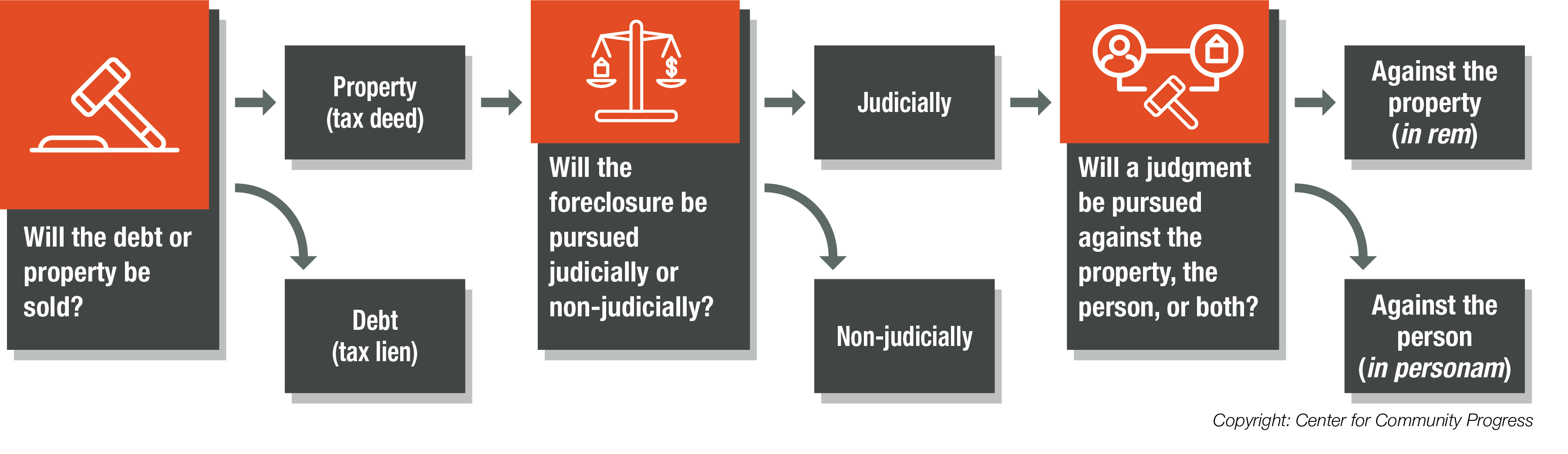
Should a Local Government Sell the Property or the Debt?
Selling the property, rather than the debt (or “tax lien“) is a more efficient and effective way of getting a vacant, tax-delinquent property back to productive use.
However, in light of municipal staffing cuts and increased need for revenue, jurisdictions across the country have reduced in-house property tax collection and enforcement efforts and instead transfer and sell the delinquent taxes, municipal liens, and the power of collection and enforcement to private buyers. This process can result in a quick infusion of revenue to cash-strapped jurisdictions, but can also have harmful, unintended consequences and render local governments passive observers as vacant properties and neighborhoods slide into decline.
Should a Local Government Pursue an In Personam or an In Rem Judgment to Recover Unpaid Taxes?
Some state laws allow local governments to pursue any amounts not recovered from the tax foreclosure sale against the individual owner (in personam) which takes considerable time and financial resources–particularly when the owner can’t be tracked down. Pursuing an in rem judgment means the liability extends only to the property; once the property is sold via the court-ordered public sale or transferred to the foreclosing governmental unit, the entire matter is resolved.
Community Progress generally advocates for local governments to focus on in rem liability, since it provides an efficient resolution of the foreclosure action. Notice must be given to all interested parties as well as published and posted physically on the property.
Judicial in rem tax foreclosure is the optimal mechanism to address vacant tax-delinquent properties, particularly those causing harm to a community.
What Incremental Property Tax Reforms Can Local Governments Make?
Recognizing that reform can take time, local governments can take steps to build momentum, such as:
- Expediting the time frame for vacant properties first. For example, shortening the time period from delinquency to foreclosure only for vacant properties.
- Ending tax lien sales for vacant properties and instead pursuing an in rem foreclosure action to bring the distressed property under local control.
- Adding abatement costs to the tax bill ensuring that the costs the government incurred from mowing grass, boarding a property, removing trash, and other services are recorded as a lien against the property and added to the minimum cost private buyers must pay at tax sale.
- Eliminating post-tax sale redemption periods will ensure the local government expends resources to move the property through foreclosure only if and after the owner fails to redeem. This also provides more certainty to private buyers at tax sale.
- Reforming noticing provisions to ensure insurable title by providing constitutionally adequate notice and reducing the need for costly quiet title actions after tax sales.
Communities should also look for additional reform opportunities related to vacant properties, such as housing and building code enforcement and land banking, which can help prevent decline and responsibly return vacant and blighted properties to productive use according to community goals.
GET HELP
If you’re looking to reform the property tax enforcement system in your community, we provide customized, expert technical assistance to assess the state of vacancy in your community and recommend policy and practice solutions for equitable neighborhood revitalization. Contact us to learn more.
Vacant Property Registration Ordinances (VPROs)
A vacant property registration ordinance (VPRO) can be an appropriate tool for some communities. These ordinances require owners of vacant properties to register with their municipality or county. Hundreds of cities, counties, and towns across the country have enacted VPROs.
VPROs serve three core purposes:
- Ensure that the city knows who owners of vacant properties are, and can reach them when necessary
- Ensure owners understand their obligations under relevant codes and regulations
- Motivate owners to meet minimum maintenance standards.
Building in a smart, realistic fee structure into the ordinance may serve additional purposes, including covering costs incurred by the municipality to deal with vacant properties and, under some circumstances, motivating owners to restore and reuse vacant properties.
A well-designed VPRO should include:
- Clear definition of which properties and which parties must register
- Registration requirements and procedures, including contact information for the owner or lienholder
- Fee structure
- Obligations of the owner, with respect to maintaining the property, carrying liability insurance, etc.
- Penalties for failing to register in timely fashion
A city might also maintain an online vacant property registry that allows residents to report unregistered properties.
Communities may also consider establishing a Vacant Building Notice procedure, under which owners of buildings identified as vacant—through inspection or a public tip submitted via app or city website—are formally notified of potential code violations. This puts owners on notice while giving the city a real-time tool for tracking vacancy trends.
VPRO Fee Structures
Fee structures can be a powerful lever for motivating property rehabilitation, though any fee structure must be legally defensible under state law and proportionate to the municipal cost of a vacant property. Vacant property registration fees vary widely; in California, for example, they range from $0 to over $600 (e.g., City of Gardena: $245, City of Pasadena: $843). Their effect can be strengthened by waiving or deferring fees for buildings scheduled for rehabilitation, or by rebating fees when a vacant building is restored to use. Some cities use graduated fee schedules that increase each year a property remains vacant.
Vacancy Taxes
A separate but related approach to VPROs is vacancy taxes (if state law permits them). Vacancy taxes are differential property tax rates: higher taxes for vacant properties than occupied ones. Their intent is to incentivize owners to sell or reoccupy a vacant property, rather than letting it stand vacant for a long period. For example, Washington, DC taxes occupied residential property at $0.85 per $100 of value, vacant properties at $5, and blighted properties at $10—part of a broader strategy that includes exemptions under certain conditions. In a strong real estate market like DC, these rates can be effective. In weaker markets, however, they risk increasing tax delinquency rather than motivating property revitalization improvement.
Do Vacant Property Registration Ordinances Work?
A vacant property registry alone will not compel unmotivated or negligent owners to rehabilitate their properties. Small fees are unlikely to change the cost-benefit calculus for an unresponsive property owner, whether a local individual or an LLC with a large portfolio of properties. While higher fees may prompt some owners to sell, in weaker markets, high or escalating fees could push owners who are at least minimally maintaining their properties to abandon them entirely, leaving the city worse off. Where that risk exists, municipalities should be prepared to take responsibility for those properties.
VPROs also won’t solve the problem of identifying abandoned properties, as owners who have walked away are unlikely to register them in the first place. The only reliable way to identify unregistered vacant or abandoned properties is through direct field observations based on an early warning system.
Compliance is also uneven. Mortgage companies are among the most likely to register and pay the registration fee because they’ve built in systems to do so; truly negligent owners are among the least. Communities should establish clear legal consequences for non-compliance—such as escalating fines that can be converted into liens, with the possibility of eventual foreclosure—to create real incentive for negligent owners to either act or relinquish the property to new, responsible ownership. If fees are only triggered by non-compliance, a property can sit vacant indefinitely without the owner ever paying.
Despite these limitations, a well-administered VPRO can still provide municipalities with valuable data on where vacant properties are located and who owns them, which is a useful foundation for broader strategy, even if it is not a solution on its own.
Vacant Property Receivership
Vacant property receivership is a legal proceeding that allows a third party—typically a municipality or a nonprofit—to petition a court for the right to rehabilitate a derelict property. The purpose of a vacant property receivership can be to preserve and restore vacant buildings at risk of demolition-by-neglect, or to remedy dangerous conditions (via health and safety receivership).
While specific provisions vary from state to state, generally receivership (called “possession” in New Jersey and “conservatorship” in Pennsylvania) works like this:
- A municipality or qualified nonprofit applies to the court to be appointed receiver of the vacant, deteriorated property.
- Once appointed, the receiver gains physical control of the property, can borrow and spend money to rehabilitate the property, and can place liens against the property for the amount spent.
- Once the property has been rehabilitated, the original owner may be able to regain control by reimbursing the receiver in whole, or the property is sold by the court or by the receiver.
Receivership is a powerful tool and a serious commitment of time and resources by a municipality or nonprofit. Key questions to ask before undertaking receivership are:
- Does state law permit vacant property receivership? Many states allow receivership, either explicitly or implicitly, but many do not. While some courts may entertain a receivership petition even without explicit state law, but it is far better to be guided by a strong state statute as in Massachusetts or Pennsylvania.
- Is the building a realistic candidate for receivership? Can it be rehabilitated, and is rehabilitation economically feasible given local market conditions and available public and private resources?
- Does the receiver’s lien have priority status? If state law does not give the receiver’s lien priority status over other liens, it may be difficult to borrow funds for the rehabilitation and recover the costs at the end of the process.
- Does state law provide a clear exit strategy? The municipality or nonprofit should be confident it has an adequate path to either recover receivership costs or transfer the property to responsible ownership after rehabilitation.
In addition to Massachusetts and Pennsylvania, New Jersey, Ohio, Indiana and the city of Baltimore have strong vacant property receivership laws.
Land Banking
A land bank is a public entity with unique legal powers to acquire vacant, abandoned, and deteriorated properties and temporarily hold them until they can be transferred to responsible new owners in line with community goals. Created through state-enabling legislation, land banks can vary in their specific powers, but ideally are able to acquire tax-foreclosed properties cost-effectively, sell to responsible buyers based on community outcomes rather than highest price, extinguish liens and clear title, hold property tax-exempt, and generate revenue through delinquent tax fees or other mechanisms.
Land banks vs. land banking programs vs. land trusts
Land banks with the unique powers described above can only be created through a state law (what we call “state-enabling legislation”). Sometimes a municipality may call their land bank a “land reutilization authority,” “land reutilization council,” or “redevelopment authority” instead.
Land banking programs, on the other hand, exist in states that don’t have state-enabling legislation, which limits their powers and utility. They may be run by governmental or nonprofit entities. There are more than 300 land banks and land banking programs across the country.
Community land trusts and conservation land trusts are distinct from land banks. A community land trust is a nonprofit that owns and provides permanent community control of land and affordable housing through ground leases. Land banks and community land trusts can complement one another. A conservation land trust is a nonprofit that owns land or conservation easements for open space purposes. See this map showing areas where land bank and community/conservation land trust service areas overlap.
What Land Banks Do and When They’re the Right Tool
Community priorities and state laws determine what land banks can do with properties. Some examples of what a land bank can do include:
- maintaining vacant structures that can be restored and demolishing the ones that can’t
- assembling property for future reuse
- turning tax-foreclosed properties into housing for all income levels
- facilitating commercial and industrial property reuse
- transforming vacant land into parks, gardens, and other community spaces
- Read The Road Ahead for Land Banks for case studies of land bank work and impact.
Land banks aren’t right for every community. They tend to work best where there are large inventories of low-value vacant properties with significant delinquent taxes and liens, inflexible public policies governing the sale of public property, widespread title problems, or unpredictable outcomes from tax auctions. A land bank is likely not the best solution for a community where most properties do not sit vacant for long, or where the real estate market is highly competitive.
LEARN MORE
Read our guide on How to Form a Land Bank.
Vacant Property Demolition
When property owners refuse to fix up their property, governments may need to step in to demolish it to protect the health, safety, and welfare of its citizens. Over the past few decades, cities faced with widespread vacancy have spent hundreds of millions of dollars demolishing properties. Despite this investment, many cities still saw the number of vacant, abandoned, and deteriorated properties rise. This is because demolition alone cannot fix widespread weak demand.
Demolition must be used as a strategic tool within a broader revitalization strategy, with a plan for open space reuse, or the pipeline of properties in need of demolition will never stop flowing. Demolition is discussed in great detail in this section, along with an overview of key questions communities should contemplate while they develop a vacant property revitalization strategy.