
community revitalization
Challenges and Opportunities to Revitalizing Historic Black Commercial Corridors


Background
In 2025, the Center for Community Progress convened three diverse Alabama communities—Montgomery, Birmingham, and the Port of Africatown (Mobile and Pritchard)—to understand their efforts to revitalize vacant, abandoned, and deteriorated (VAD) properties in historic Black commercial corridors. The “Sparkling Commercial Corridors” convening included local business and property owners, realtors, developers, community members, government partners, and creative professionals.
A mix of virtual and in-person sessions created opportunities for peer-to-peer sharing about the impacts of VAD properties, nuances of the local economic systems, and efforts at community revitalization and creative placemaking. This article summarizes what Community Progress learned from these convenings, including the historic context for these corridors and ongoing challenges to redevelopment. We also share a few examples of successful commercial reuse and reactivation projects from beyond Alabama, and recommendations for communities considering how to revitalize vacant commercial spaces.

Historic Challenges
Understanding conditions in historic Black commercial corridors requires acknowledging how racially biased policies created long-lasting barriers. For decades, communities across the Deep South experienced disinvestment, disruption, and decline tied directly to segregation and discriminatory laws.
Beginning in the 1870s, Jim Crow law mandated racial segregation in public life and institutionalized economic, educational, political, and social inequities. Black residents were barred from many commercial areas, which led Black entrepreneurs to establish businesses in corridors located near the neighborhoods where Black families were required to live. These corridors became the only places for Black families to shop, gather, and access services freely.
After the Civil Rights Act of 1964 and the Voting Rights Act of 1965 secured equal rights under the law—on paper, if not always in practice—many Black residents chose to leave these segregated neighborhoods for newer, slowly integrating communities. As customers and businesses left, Black commercial corridors began to decline, with fewer entrepreneurs and fewer residents, deepening disinvestment.
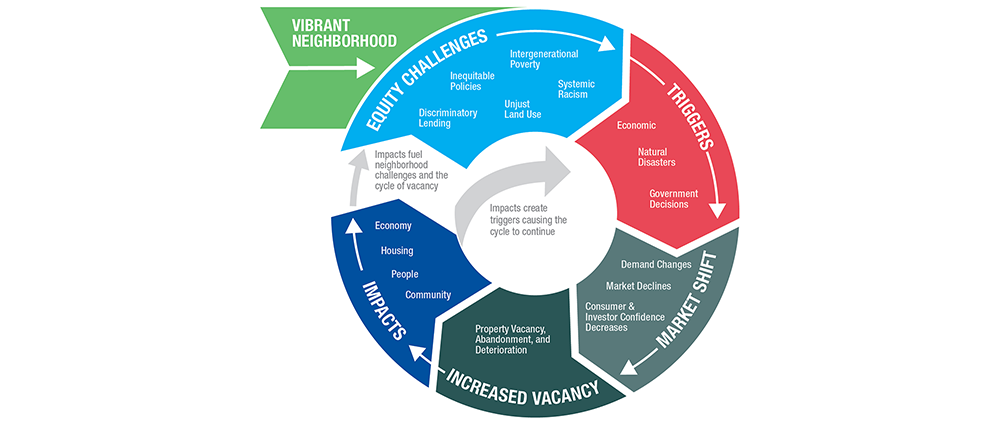
As commercial properties become vacant and deteriorated, it fuels a cycle of vacancy in communities that often become “communities of last resort.” These places have less foot and vehicle traffic, negative perceptions of being more unsafe, and continue to experience population loss and increased vacancy and property deterioration.
Why are Historic Black Commercial Corridors Challenging to Revitalize?
Ownership Challenges
Participants in the Sparkling Commercial Corridors convenings identified widespread commercial vacancy as a major barrier to revitalizing historic Black commercial corridors. Several factors contribute to this challenge. Some properties are owned by out-of-state owners who have little connection to the community and limited incentive to maintain their buildings. Other properties are tied up in heirs’ property issues, where multiple relatives may be unaware of their ownership or unable to clear title after a previous owner’s death. In other cases, if a longtime business owner passes away without a succession plan, it may leave their family unprepared to manage the property or business, which can lead to another commercial vacancy. Finally, some local property owners may indeed want to rehabilitate their aging buildings, but lack the capital to do so.
These conditions reinforce the cycle of vacancy. Owners may avoid investing in repairs when it seems unlikely to get a return on their investment, or when maintenance needs are overwhelming after years of neglect. Entrepreneurs are less likely to lease these commercial spaces because renovation or build-out costs would fall on the tenant. As the buildings sit vacant and continue to deteriorate, community disinvestment and negative perceptions deepen.
Physical and Implicit Barriers
Long-standing discriminatory policies have created economic hardships that continue to shape historic Black commercial corridors. One particularly visible example is how Black communities have been historically separated by physical infrastructure.
In Montgomery, the construction of Interstate 85—driven by segregationist state transportation commissioner Sam Engelhardt—displaced an estimated 1,700 families in West Montgomery (roughly 75 percent of whom were Black) including Martin Luther King Jr. and Ralph David Abernathy. The highway also isolated historically Black cultural and educational hubs like Alabama State University. These physical barriers continue to segregate communities today. Participants from all three communities noted similar patterns of historic harm tied to the placement of state highways, overpasses, and interstate routes.
Participants also described an “invisible hand”—the influence of local power brokers and historic families who have the power to stymie reinvestment. Participants shared the concern that these influences withhold supportive policies or funding necessary for community reinvestment and entrepreneurial growth.
Negative Community Perception
Participants highlighted negative perceptions of these corridors as being “crime-ridden” and the visible presence of VAD properties throughout the community as another major barrier to redevelopment. Indeed, many residential properties adjacent to historic Black commercial corridors share the same issues as nearby commercial buildings: heirs’ property complications and long-term neglect. These homes are often deteriorated and owned or occupied by lower-income, financially unstable residents who lack the means to do essential maintenance. The result can often be the widespread perception of the community as run-down, dangerous, and a place to avoid.
This fear of elevated crime rates, whether real or perceived, deters investment. While few studies truly quantify the relationship between VAD property and crime on a broad scale, those that do suggest that higher levels of vacancy are associated with increased violence on urban blocks. (However, research also shows that addressing vacant properties—either through removal or through maintenance and stewardship—can lead to a reduction in crime and improve community perceptions, health, and safety.) Visibly vacant properties, illegal dumping, and signs of disinvestment create a perception of disorder, which causes residents to feel unsafe regardless of actual crime rates. Residents who can afford to move often do so, further depressing the local economy, while very low-income residents lack this option. Taken together, these conditions deter potential residents from relocating to or investing in these historic communities.
Changing community perceptions of these business corridors and the neighborhoods they serve is essential to equitable revitalization. The following case studies highlight strategies for commercial revitalization through creative placemaking on vacant properties, community engagement, and strategic public-private investments.
1.
King's Canvas (Montgomery, Alabama)
Founded in 2017 by Kevin King, The King’s Canvas is a gallery and studio space in Montgomery’s historic Washington Park neighborhood. It serves as a creative hub that partners with local businesses, reactivates vacant spaces, and offers opportunities to local artists.
King strategically developed his site with community in mind. He convened local businesses and residents in a series of design charrettes to determine the best end use of the property. This early community engagement built trust, created a feeling of shared ownership, and helped bring life back to the area. Residents emphasized the need for murals uplifting local stories, reinvestment in neighborhood businesses, and opportunities to gather.
Coming out of the charettes, King reused a nearby vacant lot to host live music, entrepreneurial opportunities, and arts events. Additionally, to date, artists connected to King’s Canvas have completed 15 murals across Montgomery, and more than 80 small business owners and artists have participated in their entrepreneurial development classes. During the COVID-19 pandemic, King’s Canvas offered their outside seating to support a nearby barbecue restaurant; which helped it stay open during a difficult time and offered patrons a place to gather safely. Today, the studio includes a gallery where emerging artists can show their work and learn the business of their craft.
Through creative placemaking and support of small businesses, King’s Canvas has transformed vacant properties into economic assets supporting the revitalization of Washington Park.

2.
Washington Square (Kalamazoo, Michigan)
Washington Square, a commercial node in Kalamazoo’s Edison neighborhood, struggled for years with a concentration of adult businesses and prostitution. After community pressure led those businesses to close around 2005, the area was left with a cluster of vacant storefronts. In 2013, the Kalamazoo County Land Bank acquired several of these vacant properties and partnered with the Edison Neighborhood Association to recruit new tenants. However, the land bank found that the negative perceptions of the neighborhood that had long kept businesses and potential customers away still posed a challenge.
To generate new activity and change how people saw the neighborhood, the land bank partnered with the Arts Council of Greater Kalamazoo to host monthly “Art Hop” street festivals, which temporarily reactivated vacant spaces around Washington Square. These events helped attract arts-focused businesses to the corridor, including Tremelo, a guitar shop and BellyDance, a dance studio.
The land bank also launched “Fare Games,” a contest designed to fill a vacant restaurant space. Local food entrepreneurs competed for a fully built-out restaurant storefront along with business support services and a graduated rent schedule to help stabilize their first few years of operation. The contest ended in a community vote at Art Hop where attendees sampled the competitors’ dishes and chose a winner—Pho on the Block.
By engaging the community, the land bank could attract tenants aligned with local interests and helped breathe new life into Washington Park’s once-vacant storefronts.

3.
Beatties Ford Road Corridor (Charlotte, North Carolina)
Charlotte’s Historic West End is a network of vibrant Black neighborhoods, anchored by the campus of the historically Black Johnson C. Smith University. The Beatties Ford Road corridor is one major artery running through the West End neighborhoods. The corridor struggled with many of the same challenges as other historic Black commercial business districts, with a lack of public and private investment, concerns about inequitable policing, and deteriorated business properties.
The City of Charlotte Urban Design Center, residents, and private partners together developed a Placemaking Playbook to create a long-term plan for reactivating underutilized public land along the corridor and guide the next decade of redevelopment. Through design charettes, they identified opportunities for murals, crosswalks, streetscapes, parklets, and other public space improvements that would boost community pride and celebrate neighborhood culture and legacy. These efforts are part of the Corridors of Opportunity initiative in Charlotte to support community-driven economic development and improvements to public space and transportation along Beatties Ford Road.
Investments are already taking shape. In 2024, a new community gathering area complete with seating areas, murals, and pedestrian pathways opened at the Allegra Westbrooks Regional Library, with support from a $225,000 grant from the Knight Foundation.
Private and nonprofit partnerships are also helping to reactivate commercial properties. In 2024, Historic West End Partners acquired a 6,100 square foot shopping center at 1121 Beatties Ford Road, and is transforming it into a community hub with a corner store offering fresh food, a community meeting space, and a commercial kitchen. The $1.3 million purchase was possible with the support of LISC Charlotte, Uwharrie Bank, and a grant from Fifth Third Bank’s Neighborhood Investment Program.
Financial institutions and philanthropic partners are also investing in the corridor. As part of the Breaking Barriers to Business program—funded by the Truist Foundation’s Where It Starts initiative—Living Cities and Main Street America are directing $500,000 in grants to strengthen small business support in Charlotte’s corridors, including Beatties Ford Road. Fifth Third Bank also opened a branch on Beatties Ford Road in 2025, expanding access to financial infrastructure in a historically underbanked community. They presented $100,000 grants to five small local businesses to help them continue growing, and support a range of other initiatives in the neighborhood to build and renovate quality, affordable housing.


Recommendations for Revitalizing Historic Black Commercial Corridors
Cross-Sector Stakeholder Collaboration: Strong stakeholder collaboration is essential to revitalizing historic Black commercial corridors. For example, partnerships with local land banks can help community stakeholders and developers more affordably acquire property. Merchant or business associations—like local chambers of commerce or business improvement districts—can also help strengthen commercial corridors by streamlining licensing, supporting legacy business planning processes, providing façade grants to improve a storefront’s appearance, and serve as a hub for community engagement and problem-solving. Temporary activations in partnership with local businesses—like Kalamazoo’s Art Hops or The King’s Canvas turning a vacant parcel into an outdoor performance space—can stabilize commercial areas, spark new permanent uses, and build a feeling of community cohesion and stability that can spur broader corridor revitalization.
Innovative Financing Models and Public-Private Funding Partnerships: Revitalizing historic Black commercial corridors requires coordinated investment strategies that blend public, private, and philanthropic funding. Flexible, relationship-driven capital (like RUNWAY Roots’ reparative financing model) can help entrepreneurs who have been excluded from traditional lending access the funds and support they need. At the same time, public-private partnerships are essential in strengthening commercial districts. In Charlotte’s Historic West End, the acquisition and renovation of a shopping center on Beatties Ford Road was made possible through a mix of bank financing, foundation support, and mission-driven capital.
Community Engagement: Finally, meaningful community engagement is critical. Design charettes, listening sessions, and neighborhood-led planning efforts help ensure that redevelopment reflects what residents actually want and need. When people are invited to shape the vision—from identifying what kinds of businesses are needed, to reimagining vacant lots—they develop a stronger sense of ownership in the process. These early conversations also help shift long-standing negative perceptions of a corridor by showing visible momentum, strengthening trust, and demonstrating that investment is responding to local priorities. Whether it is The King’s Canvas gathering neighbors to guide the reuse of an underutilized vacant lot, or Charlotte residents shaping public space improvements along Beatties Ford Road, engagement that centers community expertise builds credibility and lays the groundwork for sustained revitalization.
Conclusion
These examples and stories from participants in the Sparkling Commercial Corridors project show how intentional community engagement, creative property reactivations, and targeted investments can revitalize vacant properties. When local stakeholders work together, they can help historic Black commercial corridors regain their economic and cultural strength. Continued support in the form of reparative financing and cross-sector partnerships will be essential to long-term, community-centered change.
Project Credits
Writing and Design: Tasha Hall-Garrison, Maria Elkin
This work is made possible with generous support from the Truist Charitable Fund.
Subscribe to join 14,000 community development leaders getting the latest resources from top experts on vacant property revitalization.