Vacant Land Elements Examples
Vacant land stewardship requires four fundamental elements: knowing your community’s context, having clear goals and plans, committing to collaboration, and enacting facilitative policies. These four elements will look different in every community, but they are all critical components of implementing successful vacant land stewardship. To learn more about these elements and discover some next steps for your community's learning journey, explore the element examples below.
Element Type
Organization
City of Harrisburg
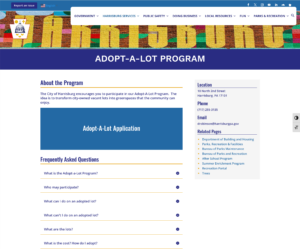
The City of Harrisburg’s Adopt-A-Lot program allows people to “adopt” city-owned vacant lots for the purpose of maintaining and beautifying them.
Read More »
Land + Water WORKS Coalition
The Land + Water WORKS Coalition is a collective of environmental stewards dedicated to a more equitable, more climate-resilient future for Detroit through research, education, outreach, technical assistance, installation, and advocacy.
Read More »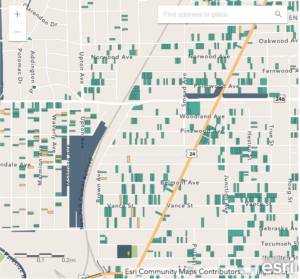
City of Toledo, Ohio
With the help of 52 community mowing partners, the City of Toledo, Ohio’s grass mowing program works each summer to keep parks, neighborhoods, and boulevards neat and tidy.
Read More »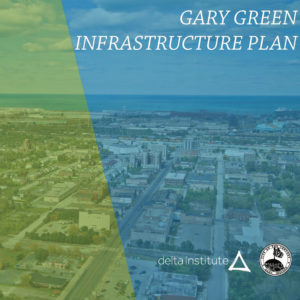
City of Gary
The Gary Green Infrastructure Plan is a city-wide framework for green infrastructure. The plan integrates with broader land use planning and redevelopment efforts and details existing conditions. Importantly, it provides tools, strategies, and recommendations for project prioritization and discusses management,…
Read More »
St. Louis Vacancy Collaborative
“The St. Louis Vacancy Collaborative is a coalition of community members, private and nonprofit stakeholders, and City agencies committed to reducing vacant property in St. Louis. The Collaborative helps to coordinate existing vacancy efforts under one umbrella and empowers the public and…
Read More »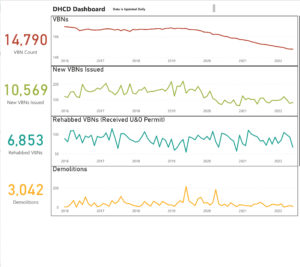
City of Baltimore
Baltimore’s Open Data Portal provides access to hundreds of datasets and interactive dashboards. The Vacant Building Dashboard shares data on number of vacant building notices, building rehabs, and demolitions. The data can be sorted and filtered by geographic bounds, time…
Read More »
City of St. Louis Land Reutilization Authority
The ‘Mow to Own’ Program is allows residents who own an occupied residential or commercial property to purchase adjacent vacant lots for $125. Applications are submitted to the St. Louis Land Reutilization Authority (LRA) Board of Commissioners for review. Following approval, the successful applicant receives a deed to the property with a two-year maintenance lien.
Read More »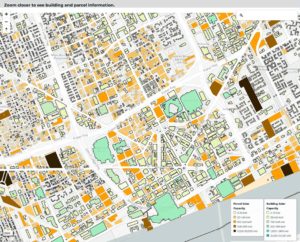
City of Detroit
The Detroit Solar Map shows the potential solar energy for buildings and vacant lots within the Detroit city limits.
Read More »
Saginaw Basin Land Conservancy
The Pollinator Project uses re-naturalization techniques to stabilize vacant urban land in Saginaw, MI. Through a partnership with the Saginaw County Land Bank, the Pollinator Project has transformed over half the land bank’s vacant lot inventory. Other partners, including community…
Read More »
City of Flint
The repurposing of vacant properties is a central component of Imagine Flint. Recognizing that some areas of Flint cannot continue to exist as they do today, Flint residents have chosen to adapt and transform their neighborhoods and commercial corridors into…
Read More »Elevated Chicago
In Elevated Chicago’s report, a case study of two areas in Chicago near transit hubs discuss the impact of vacant lots as well as the potential they hold for the area.
Read More »University of Michigan, School for Environment and Sustainability
A study led by the University of Michigan and the University of Michigan-Dearborn aims to understand the connection between vacant lot maintenance, such as greenwater storm infrastructure (GSI), and subsequent mental health effects.
Read More »Groundwork USA
The New Orleans Green Infrastructure Map is an ArcGIS map, created in partnership with Groundwork USA, Groundwork New Orleans and several community partners, seeks to document the various greening initiatives across the city of New Orleans.
Read More »Pennsylvania Horticulture Society (PHS)
The Green Equity Initiative by the Pennsylvania Horticulture Society (PHS) is a proposal for environmental neighborhood investment in Philadelphia in the form of neighborhood-based greening solutions.
Read More »Connecticut Department of Economic and Community Development’s (DECD)
The Brownfield Remediation and Development Program provides $24.6 million in state funding to remediate 41 VAD properties across Connecticut.
Read More »Environmental Protection Agency (EPA)
The EPA Region 5 Brownfields Map is an ArcGIS visual of various brownfield redevelopment success stories in the Midwest. The map has 30 examples with descriptions of projects including environmental assessments, redeveloping spaces into medical complexes, housing, a museum, etc..
Read More »Lincoln Institute of Land Policy
The Greening America’s Smaller Legacy Cities from the Lincoln Institute of Land Policy is a policy-focused report on how local governments in small and midsize older industrial cities can adopt and implement comprehensive sustainability initiatives.
Read More »Trumbull Neighborhood Partnership
The Garden Resources of Warren (GROW) Program provides technical support leadership development, and educational programming for Warren’s community gardens and operates the Warren Farmer’s Market. Operated by the Trumbull Neighborhood Partneship,
Read More »Metropolitan Planning Council
A pilot report from the Metropolitan Planning Council and Emerald South explore how greenwater storm infrastructure (GSI) can be implemented based on local sewer conditions and vacant lot availability for efficient stormwater management.
Read More »Calhoun Land Bank Authority
Led by the Calhoun County Land Bank Authority the Washington Heights Land Re-Use Strategy seeks to revitalize the Neighborhood Planning Council 2 (NPC2) area of Battle Creek, Michigan. Led by the Calhoun County Land Bank Authority
Read More »