
Auditing Louisville, Kentucky’s Code Enforcement Program Through an Equity Lens

Centering Equity in Code Enforcement—and Getting Results
The City of Louisville, Kentucky has a long history of leading efforts to address vacant and abandoned properties. However, it also has a complicated history of racist land use policies which have contributed to systematic disinvestment in the city’s historic and predominantly Black West End neighborhoods.
Louisville Metro Government’s (LMG) Building Codes and Regulations team knew they needed to do more. Their complaint-based system, which relied on fines and penalties, was disproportionately burdening predominantly Black, low-income residents who had few financial options to come into compliance. Reform was necessary.
THE TASK
Community Progress competitively selected LMG to attend the Vacant Property Leadership Institute (VPLI), where LMG’s leaders explored more equitable approaches to code enforcement. Afterwards, LMG applied for and was awarded a competitive technical assistance scholarship from Community Progress to put those lessons into practice.
The goals of the engagement were to understand the historical context of neighborhood disinvestment and housing condition disparities, and to identify reforms to more equitably and effectively deploy code enforcement to achieve increased compliance.
SOLUTION
Community Progress worked with LMG to design and facilitate a one-day workshop for local government leaders and their partners.
The workshop trained attendees on why and how code enforcement must be integrated with delinquent property tax enforcement and land banking to be most effective. Interactive exercises and small group simulations fostered peer-to-peer learning, helping participants learn about each department’s strengths and limitations. Participants also identified opportunities for cross-departmental coordination.
Before the workshop, we met with code officers to build step-by-step process maps that aligned with their experiences while offering opportunity for process improvements. During the workshop, participants used these maps to brainstorm more effective approaches for code enforcement on different property types (vacant, owner occupied, tenant-occupied). Code officers and supervisors worked alongside our team to identify critical decision points and explore alternative policies and practices to achieve more equitable outcomes.
The result was that frontline code officers felt both heard and empowered to take a more equitable, efficient, and effective approach in their work.
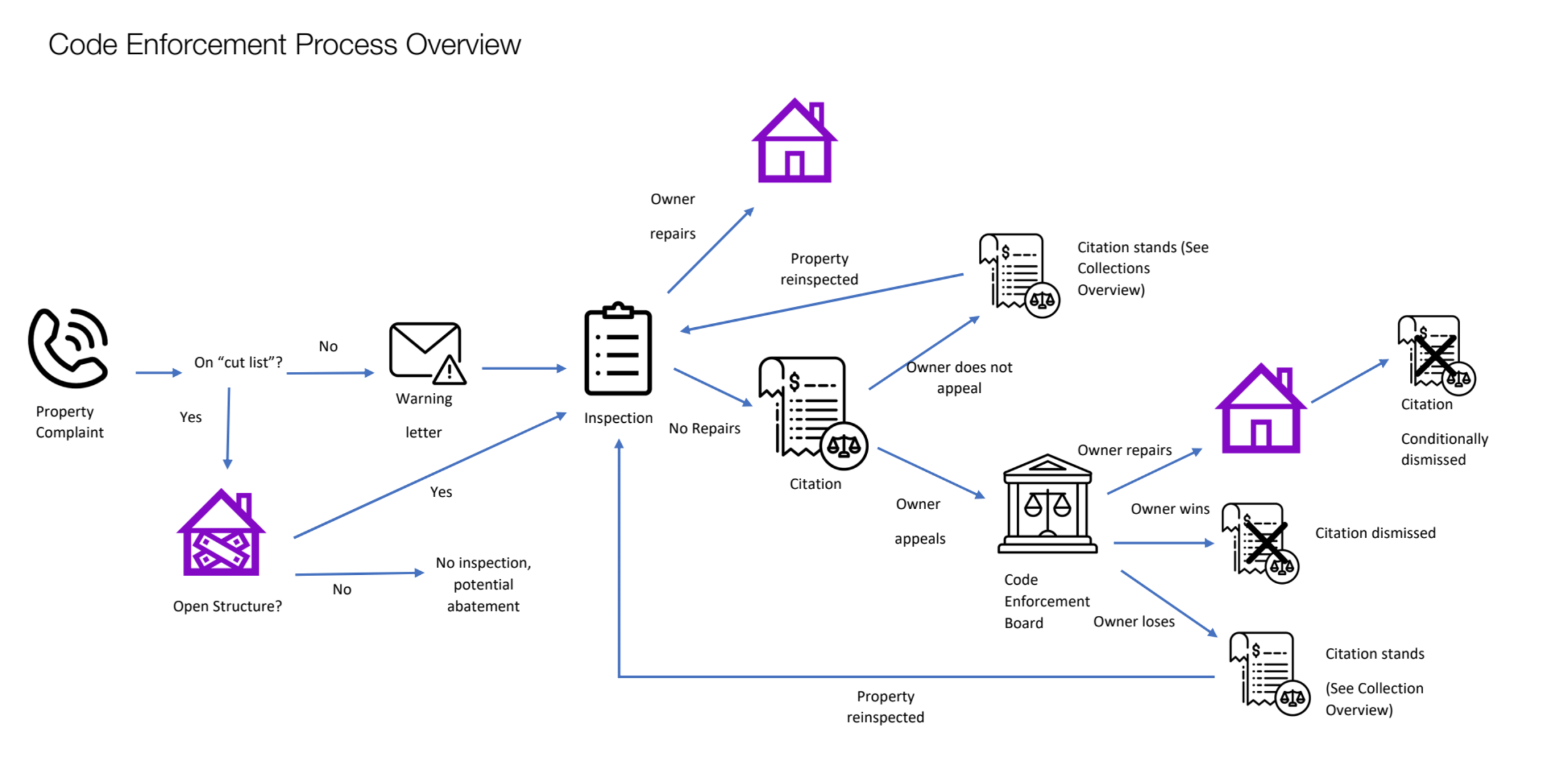
The code enforcement process overview developed by Community Progress and LMG before the workshop.
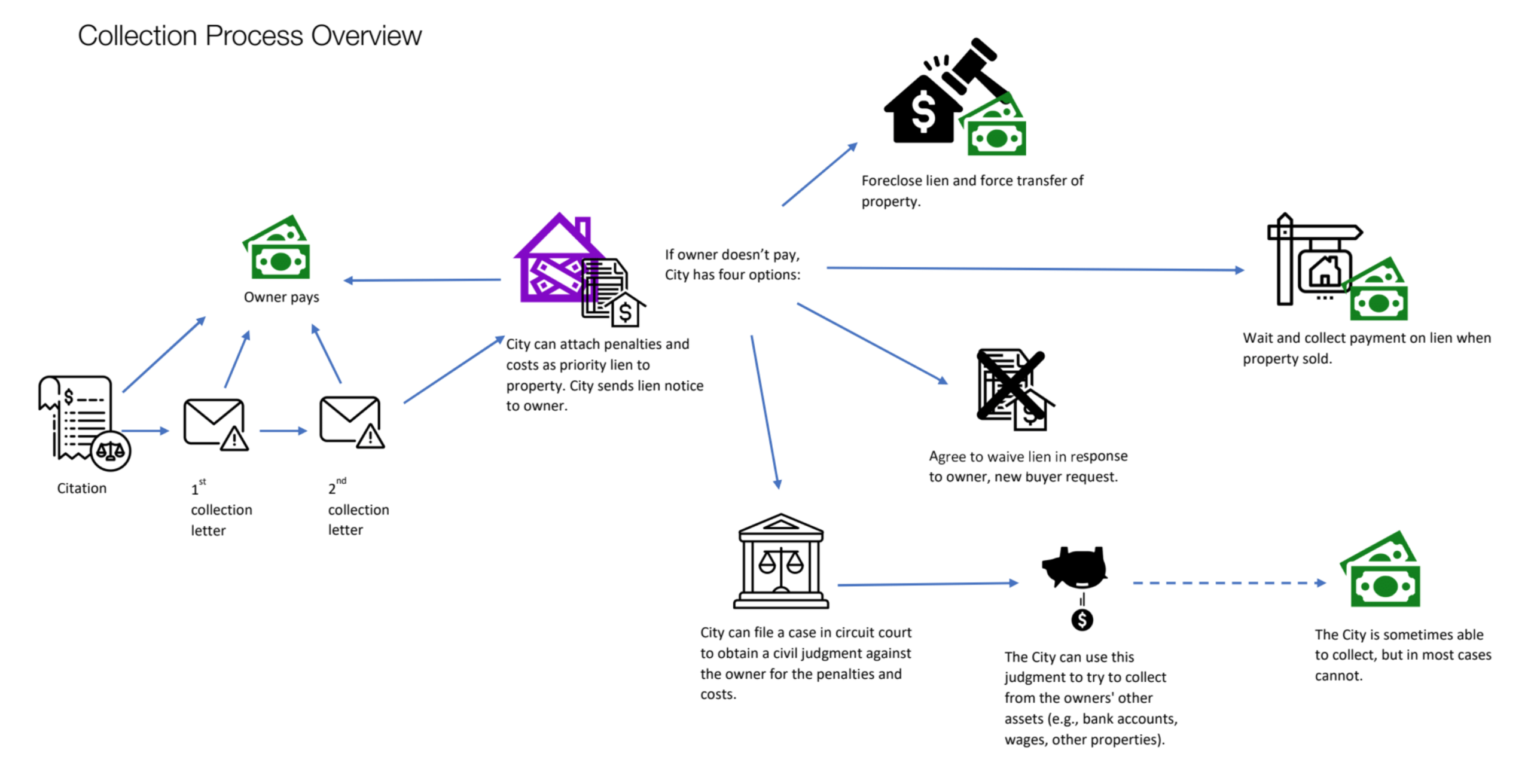
The collection process overview developed by Community Progress and LMG.
IMPACT
LMG moved quickly to adopt reforms developed by Community Progress and the workshop attendees.
These reforms included:
- expanding the number of abandoned properties on the “cut list” that LMG maintains to reduce harm to neighbors
- referencing the “cut list” before responding to a complaint and only responding to complaints on these properties if there is an open structure, shifting the strategy from penalties to timely abatement
- restoring code enforcement officers’ ability to give property owners warnings for certain violations before issuing citations, on a discretionary basis
- restoring code enforcement officers’ ability to request supervisors waive citations and fines in certain circumstances when owners have made repairs
- reducing the time between notice and reinspection for certain nuisance violations, such as high grass or junk and debris
- creating more equitable offramps in the code enforcement process for low-income homeowners, including working with Develop Louisville to dedicate $1 million of new home repair assistance funds to properties referred by the Codes and Regulations
Highlights From Our Analysis


Louisville, KY
Project Date: 2022
Services: Racial Equity Analysis
Client: Louisville Metro Government
“The technical assistance team created an opportunity for us to have constructive conversations with stakeholders together in one place with the material presented in a way to capture everyone’s interest.”—Laura Grabowski, Director, Office of Housing & Community Development at Louisville-Jefferson County Metro Government
“The Center for Community Progress is the expert when it comes to vacant, abandoned properties. Every city and town in American needs to contract with them to work on vacant and abandoned property issues. I use them as a resource regularly to help improve our neighborhoods for our city’s residents.”—Phil Crowe, Assistant Director for Code and Regulations, Office of Housing & Community Development at Louisville-Jefferson County Metro Government
Interested in these services for your community? We can help! Contact the Technical Assistance Team »
Subscribe to join 14,000 community development leaders getting the latest resources from top experts on vacant property revitalization.