Analysis of Bulk Tax Lien Sale in Rochester, New York
The False Hope of Privatizing Delinquent Tax Enforcement
To reduce costs and increase collection rates, the City of Rochester began selling delinquent tax liens in bulk to a single investor in 2009. The City hoped privatizing this process would ease the burden of in-house tax collection and enforcement and relieve growing fiscal pressures.
However, unintended consequences of this decision quickly emerged. A growing inventory of vacant, abandoned, and tax-delinquent properties strained city resources through increased public safety and code enforcement calls and caused real harm to neighbors. By selling its tax liens, the City had effectively surrendered its authority to foreclose on these problem properties, closing off the pathway to new, responsible ownership.
THE TASK
In 2012, Rochester competitively selected Community Progress to analyze its tax sale system and identify the optimal approach to maximize tax revenue; minimize the harms from vacant, tax-delinquent properties; and treat residents and taxpayers equitably.
Experienced in navigating complex political dynamics, our team quickly built trust with Rochester’s leaders. Our approach combined rigorous data analysis, legal research of state and local laws, and respectful, inclusive stakeholder facilitation.
We acknowledged the City’s real fiscal pressures and challenges with many long-vacant properties, while at the same time respectfully challenging assumptions that did not align with the data, research, or our experience working with hundreds of communities on similar issues.
SOLUTION
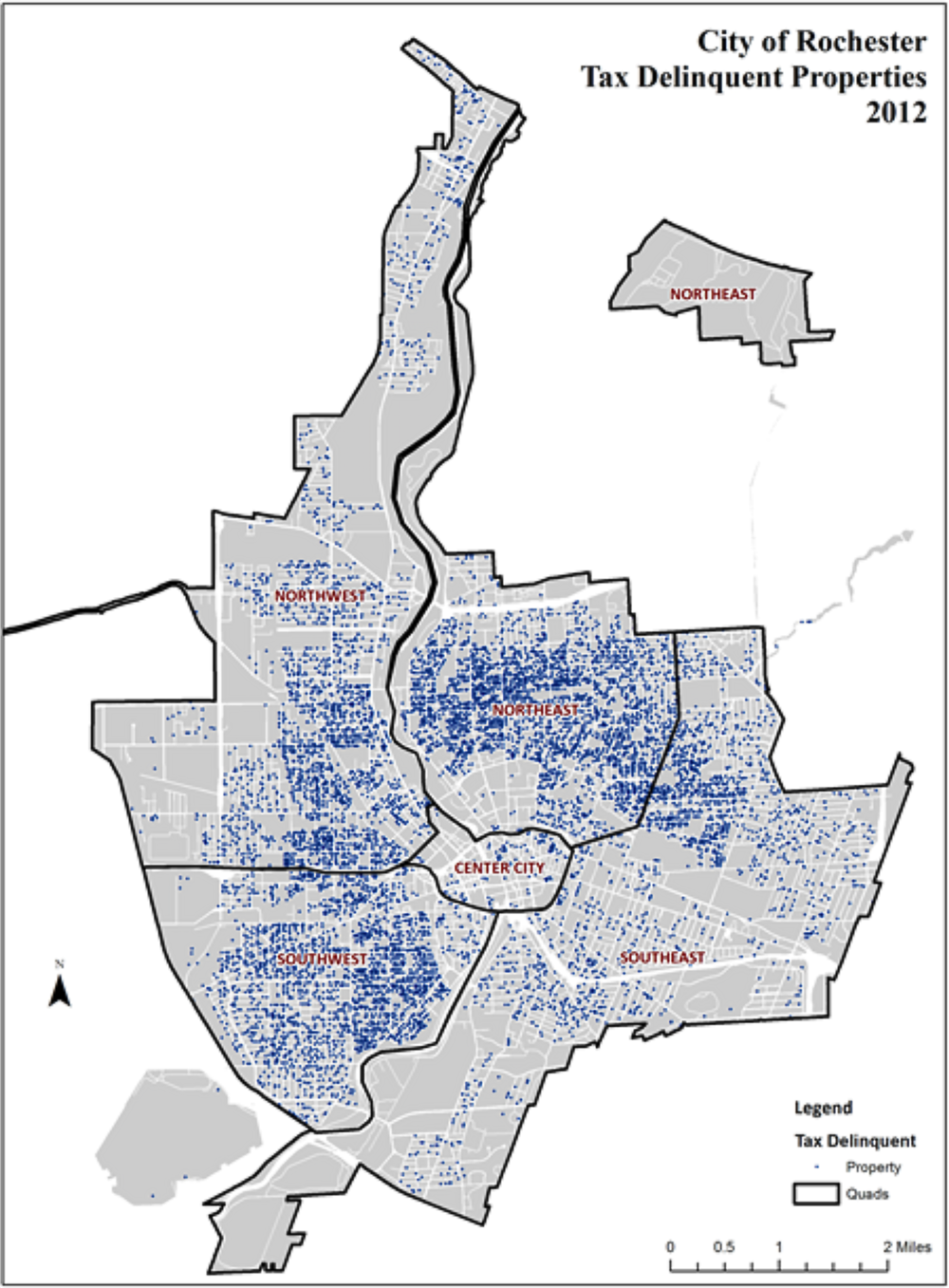
Our analysis uncovered the troubling consequences of the tax lien sale: A new inventory of “limbo properties”—properties where the tax lien investor could not settle the outstanding taxes with the property owner and chose not to foreclose on the property to take ownership—were having harmful effects. These limbo properties:
- had higher rates of vacancy and code violations
- were more likely to generate police calls and negatively impact sale prices of nearby homes
- were more likely to be in distressed neighborhoods with higher populations of Black and Brown residents and higher rates of poverty and unemployment
- continued to stay tax delinquent
These factors forced the City to pour significant public resources into properties it did not control.
Community Progress’ analysis helped Rochester’s leaders build consensus on how delinquent property tax enforcement shapes neighborhood stability. When used purely as a short-term revenue mechanism, it can harm communities for years to come.
We also identified opportunities to transform the enforcement system into a community development tool that could help interrupt the cycle of decline.
IMPACT
We advised the City to end the bulk sale of tax liens to private investors and instead hire a third party to manage delinquent tax enforcement. If the City was not ready to stop the sale of tax liens entirely, we recommended at minimum excluding liens on vacant, abandoned, or deteriorated properties to retain control over the parcels most harmful to neighborhoods.
Rochester initially reduced its delinquent tax lien sales by nearly 50 percent, then, a few years later, ended the bulk sale process entirely.
The decision to end bulk tax lien sale resulted in the use of judicial in rem foreclosure—selling the property rather than the debt—to resolve long-standing vacant, tax-delinquent properties. It also gave the City the ability to transfer vacant properties to the Rochester Land Bank Corporation for temporary stewardship and eventual reuse in line with community goals.
Since then, the land bank has secured over $33 million public and private investments and returned $2.5 million in assessed value to the tax rolls.
Highlights From Our Analysis
Our Analysis: The Effect of Intervention on Code Violations and Property Vacancy
| Intervention | City issues Notice of Intent to Foreclose – 2005 and 2007 | City issues Notice of Intent to Foreclose – 2009 and 2010 | ATFS purchases tax lien | City sells property at tax auction | ATFS forecloses and sells to 3rd party |
|---|---|---|---|---|---|
| Percent of properties with code violations at time of intervention | 38.7% | 81.0% | 37.8% | 75.4% | 30.4% |
| Percent of properties with code violations 4 quarters later | 40.3% | 56.7% | 41.6% | 53.8% | 34.1% |
| Percent of properties with code violations 8 quarters later* | 39.4% | 32.1% | 38.1% | 41.8% | N/A |
| Intervention | City issues Notice of Intent to Foreclose – 2005 and 2007 | City issues Notice of Intent to Foreclose – 2009 and 2010 | ATFS purchases tax lien | City sells property at tax auction | ATFS forecloses and sells to 3rd party |
|---|---|---|---|---|---|
| Percent of properties vacant at time of intervention | 13.6% | 72.3% | 15.3% | 60.8% | 96.1% |
| Percent of properties vacant 4 quarters later | 17.2% | 68.3% | 18.5% | 58.2% | 9.1% |
| Percent of properties vacant 8 quarters later | 18.3% | 50.0% | 19.4% | 31.9% | N/A |

Rochester, NY
Project Date: 2013
Services: Tax Lien Sale Analysis
Client: City of Rochester, New York
Interested in these services for your community? We can help! Contact the Technical Assistance Team »
Subscribe to join 14,000 community development leaders getting the latest resources from top experts on vacant property revitalization.