West Jackson Property Condition and Resident Perception Survey Findings
Assessing the Cost of Vacant Properties in Mississippi's West Jackson Neighborhood
Topic(s): Local Analysis, Parcel Data & Neighborhood Markets
Published: March 2026
Geography: Mississippi
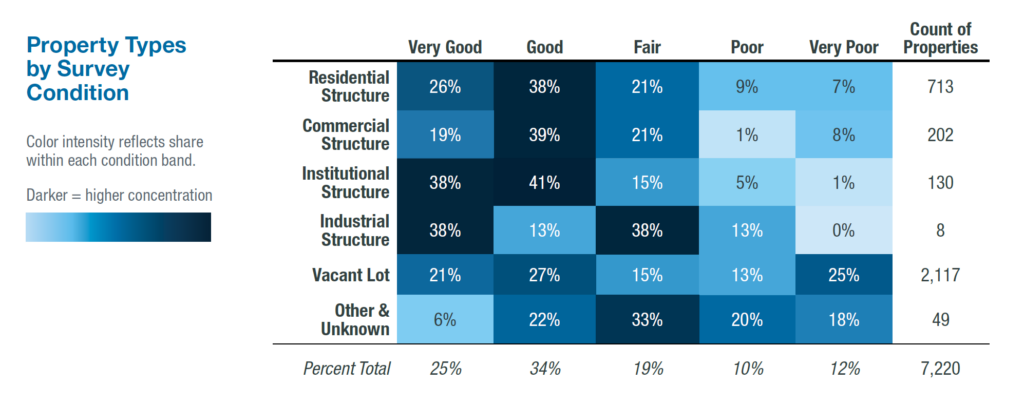
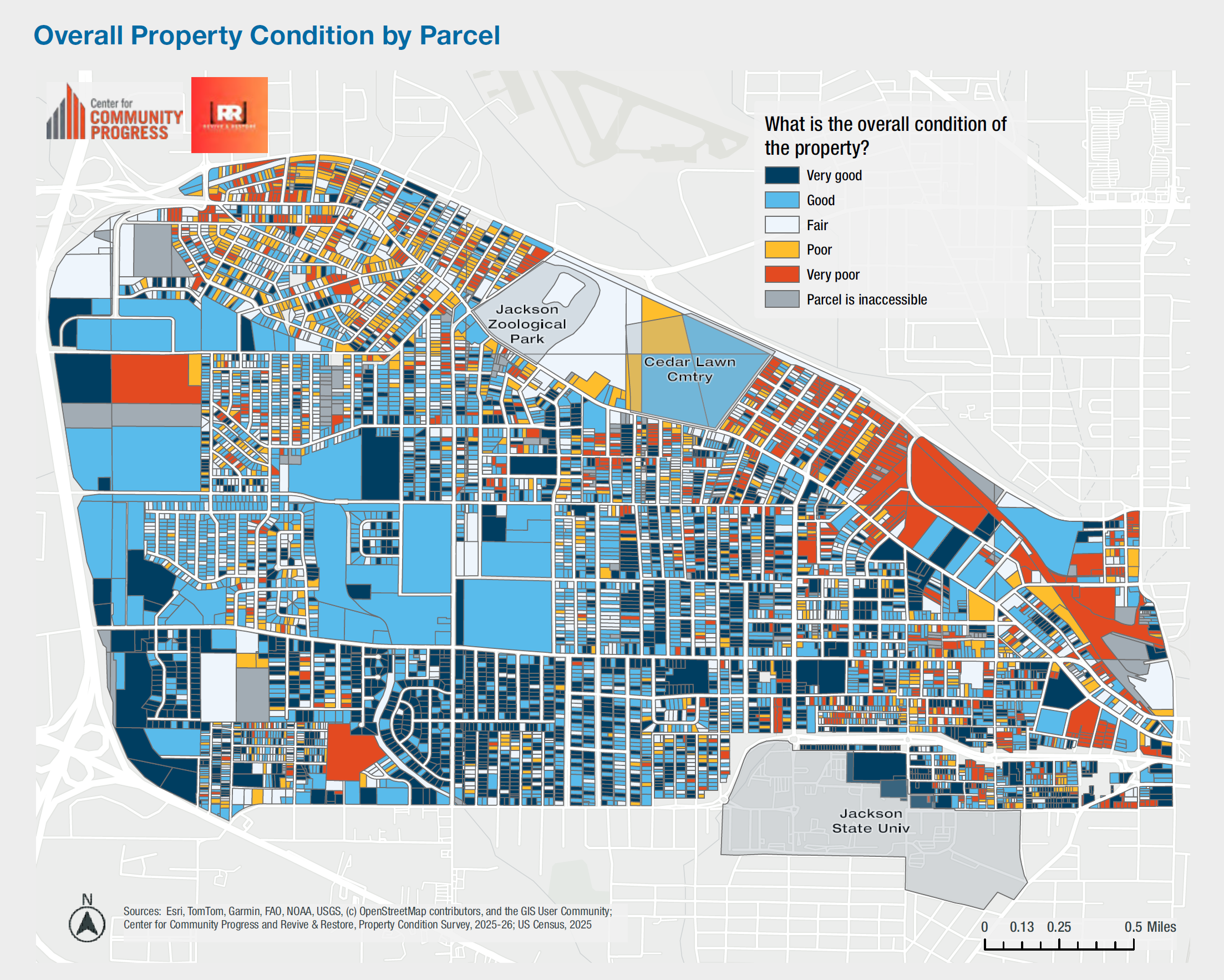
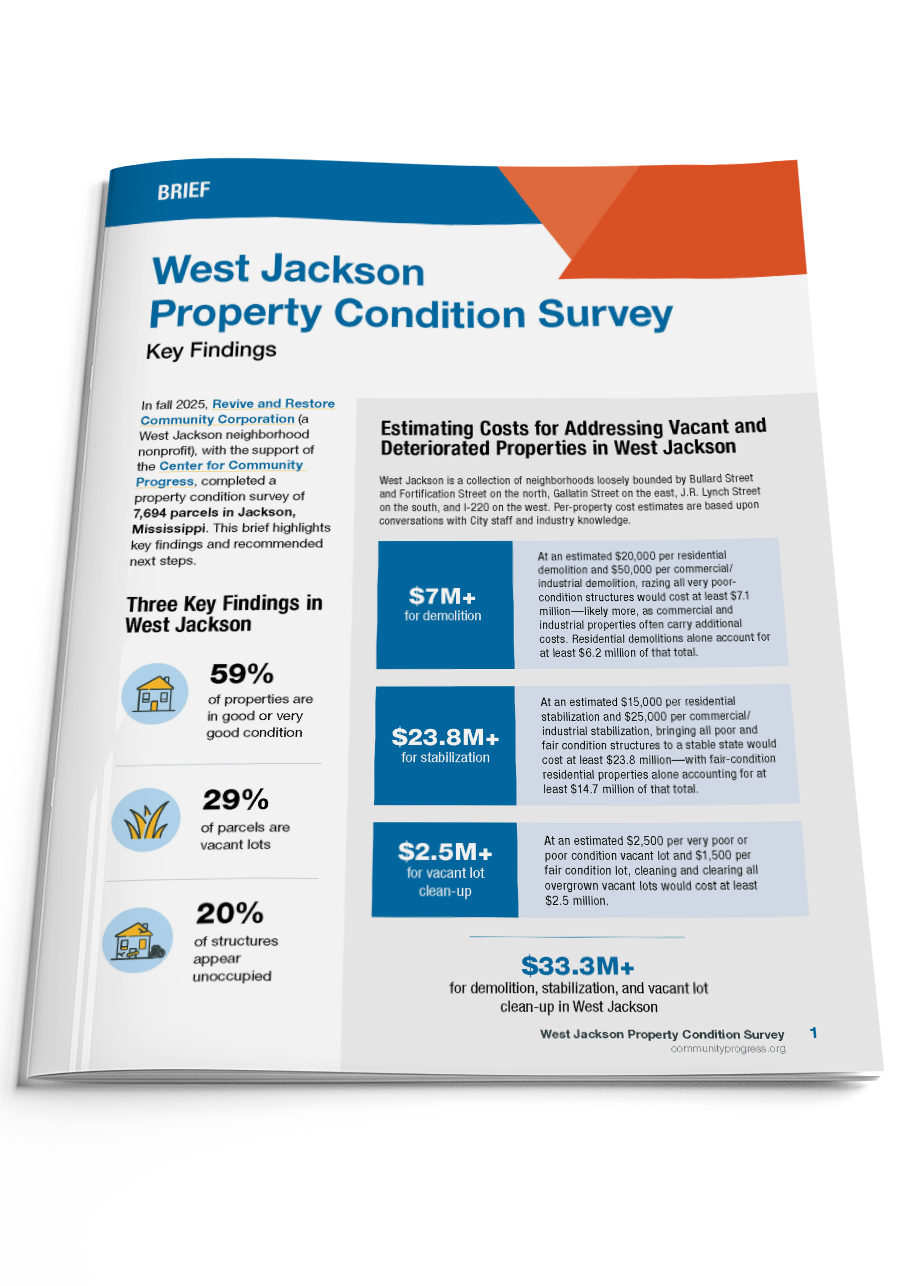
In fall 2025, Revive and Restore Community Corporation (a West Jackson neighborhood nonprofit), with the support of the Center for Community Progress, completed a property condition survey of 7,694 parcels in Jackson, Mississippi.
Three Key Findings About Property Conditions in West Jackson
- 59% of properties are in good or very good condition
- 29% of parcels are vacant lots
- 20% of structures appear unoccupied
Estimated Cost of Addressing Vacant and Deteriorated Properties in West Jackson
West Jackson is a collection of neighborhoods loosely bounded by Bullard Street and Fortification Street on the north, Gallatin Street on the east, J.R. Lynch Street on the south, and I-220 on the west. Per-property cost estimates are based upon conversations with City staff and industry knowledge.
- $7 million+ for Demolition: At an estimated $20,000 per residential demolition and $50,000 per commercial/industrial demolition, razing all very poor-condition structures would cost at least $7.1 million—likely more, as commercial and industrial properties often carry additional costs. Residential demolitions alone account for at least $6.2 million of that total.
- $23.8 million+ for Stabilization: At an estimated $15,000 per residential stabilization and $25,000 per commercial/industrial stabilization, bringing all poor and fair condition structures to a stable state would cost at least $23.8 million—with fair-condition residential properties alone accounting for at least $14.7 million of that total.
- $2.5 million+ for Vacant Lot Clean-Up: At an estimated $2,500 per very poor or poor condition vacant lot and $1,500 per fair condition lot, cleaning and clearing all overgrown vacant lots would cost at least $2.5 million.
- This brings the grand total for demolition, stabilization, and vacant lot clean-up in West Jackson to $33.3 million+.
Next Step Considerations for Addressing Vacant and Deteriorated Properties in West Jackson
The property condition survey, along with our other work in Jackson, points to several immediate and long-term next steps. Five are outlined here, and additional recommendations can be found in our “West Jackson Property Condition and Resident Perception Survey Findings” and “Assessment of Code Enforcement Activities and Priorities to Consider” memorandums.
- Conduct Additional Analysis: Partner with City of Jackson Code Enforcement, Working Together Jackson (which recently completed a market value analysis), and others to analyze property condition survey data alongside code enforcement, market, and other data to inform intervention strategies. Every Neighborhood Has a Future…And it Doesn’t Include Blight: Detroit Blight Removal Task Force Plan and Beyond Blight: City of Flint Comprehensive Blight Elimination Framework offer useful models for how other communities have combined these data sources.
- Survey the Entire City: Property condition data is most powerful when it covers all properties and can inform citywide strategy. A full Jackson survey is estimated at $250,000–$300,000, depending on survey staffing and compensation. The City and partners should secure funding to make this happen, ideally surveying the entire city within a single time frame and repeating every two to three years. If only incremental funding is available, additional neighborhood surveys are still worth pursuing. The existing survey will also need minor refinements before scaling, such as updated definitions and descriptions. The Flint Property Portal and City of Cleveland Property Inventory are strong examples of citywide survey efforts.
- Establish a Citywide Vacant Property Coalition: Meaningful progress requires a unified, coordinated strategy among all partners. Additional data gathering, analysis, and community engagement will be needed to develop that strategy. An important first step is convening all interested parties to build shared understanding and elevate resident voices. The coalition could be led by the Mayor’s Office or an independent representative board. The St. Louis Vacancy Collaborative is a strong example of the latter.
- Launch a Coordinated Storytelling and Fundraising Campaign: Draw on current and future survey results to build a collaborative public education campaign that makes the case for greater local capacity and financial investment in revitalization. The coalition should engage communications and marketing professionals to identify the most effective formats (e.g., infographics, videos, visual storytelling) to reach target audiences. The Lucas County Land Bank’s Toledo Survey is a useful reference for translating data findings into compelling public narratives.
- Explore Local Legal Tools and State Policy Changes: Existing policies and practices constrain progress. Mississippi’s delinquent property tax enforcement laws allow vacant properties to languish for years, and code enforcement tools—despite staff’s best efforts—often fail to compel action from absentee owners. These systems need reform. The most effective strategy for harmful vacant properties is to move them to new responsible owners as quickly as possible. Whether and how to pursue this in Jackson should be explored through deeper community engagement, a review of historical city practices, and careful analysis of existing law.
Topic(s): Local Analysis, Parcel Data & Neighborhood Markets
Published: March 2026
Geography: Mississippi
Related Publications
Other Related Content
Subscribe to join 14,000 community development leaders getting the latest resources from top experts on vacant property revitalization.