How Land Banks Can Address Brownfields: Case Studies
March 12, 2026
Topic(s): Brownfields, Land Banks
Land banks are well-positioned to engage in brownfield redevelopment. As public entities with unique powers to address vacant, abandoned, and deteriorated properties, land banks can help communities return these properties to productive use in alignment with community goals.
A growing number of communities across the country are seeing land banks lead and partner in this brownfields work. In Ohio, state leaders have committed over $900 million to support brownfield assessments and cleanup projects through its statewide Brownfield Remediation Program. The funding has the potential to put $4.5 billion back into the state’s economy. In communities with county land banks, the land bank must serve as the lead entity on all applications and grant awards.
At the Center for Community Progress, we have been showcasing the diverse approaches land banks throughout the country take to revitalizing brownfields. Our Land Banks and Brownfields: Case Studies publication highlights three of these land banks:
The work of these land banks demonstrates the persistence required to see projects through, the power of partnerships, and the importance of community engagement and planning with most-impacted residents at the center.
West Virginia Land Stewardship Corporation
Fairmont Rail Trail Project
The Fairmont Rail Trail project is anticipated to connect 11 neighborhoods, provide riverfront access and trails for exercise, soccer fields, playgrounds, and equitable multi-modal transportation. It will be included in the over 255 miles of recreational trail systems stretching from West Virginia to Pennsylvania.
Project Timeline
- 2014: The City of Fairmont initiates $19 million Rail Trail Project, and seeks to acquire, combine, and remediate 21 parcels on the city’s west side.
- 2022: The City and Northern Brownfields Assistance Center at West Virginia University (NBAC) enlists West Virginia Land Stewardship Corporation (WVLSC) for assistance. Using the land bank’s existing U.S. Environmental Protection Agency (EPA) Community-wide Assessment Grant, WVLSC completes Phase I and II Environmental Site Assessments (ESAs).
- 2024–2025: WVLSC and partners begin remediation oversight, including demolition of glass factory and several additional unsafe structures, soil remediation, and trail development.
- 2025: The City of Fairmont expands trail project, securing a $450,000 state grant to be used for the demolition of former Fairmont Box Factory. The City also unveils plans for Momentum Adventure Parks, an additional extension, which will feature a recreational facility that includes a skate park, bouldering wall, pump track, and skills course.
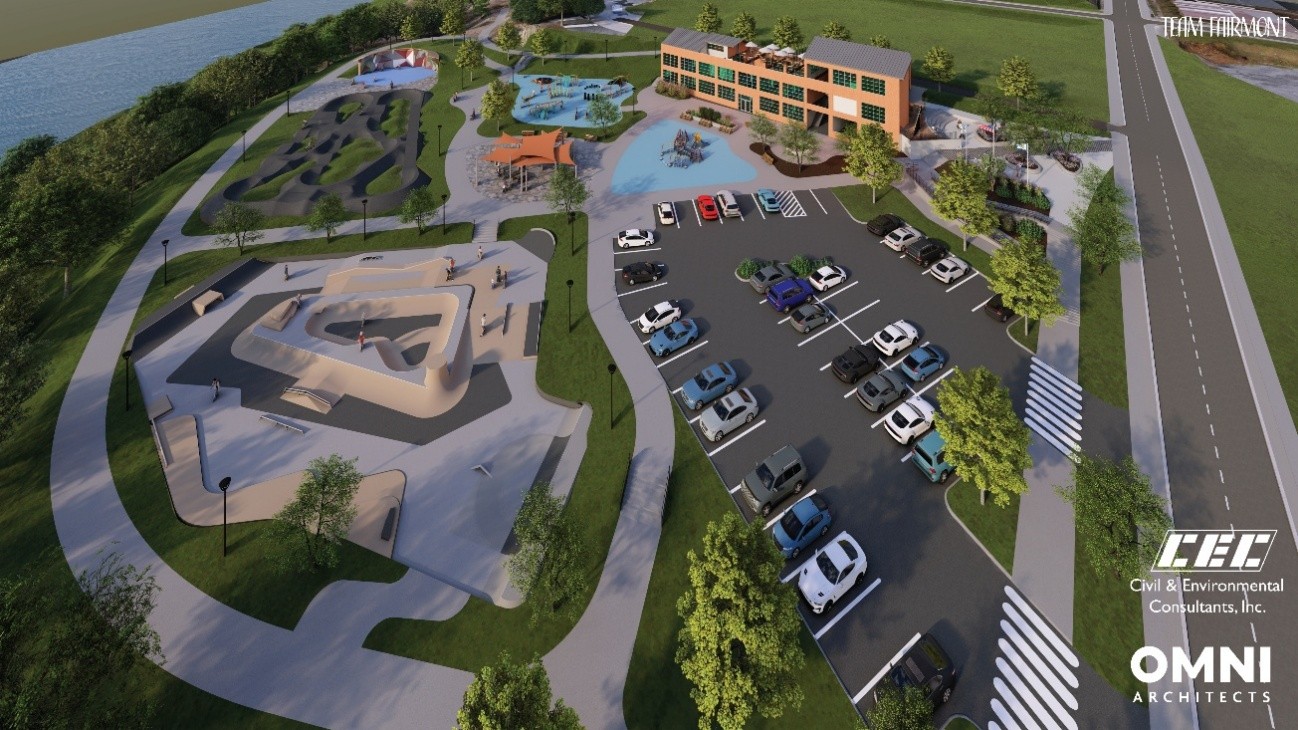
WVLSC played a crucial role in the Fairmont Rail Trail Project by assessing this property to facilitate its timely transfer to the City. Since WVLSC completed environmental testing in 2022, the City has successfully drawn down over $1 million in grant funding for this project, demonstrating how crucial cross-sector partnerships are to successful property reuse.
The Smokestacks
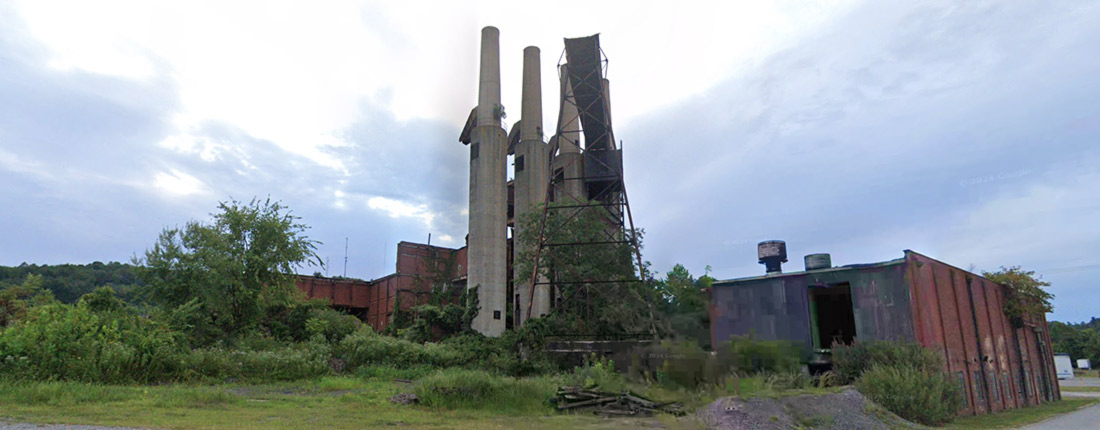
Within the footprint of the Morgantown Industrial Park, the 2.1 acre “Smokestacks”—named for its looming industrial chimneys—was once home to a World War II-era coal-fired chemical plant and water treatment facility. The plant operated from 1941 to 1945 and then sat abandoned for decades. Its prior function resulted in significant soil contamination, including high levels of mercury and asbestos.
Project Timeline
- 2019: WVLSC uses part of a $300,000 EPA Brownfields Assessment Grant to fund Phase I and II ESAs.
- 2020: WVLSC receives a $500,000 EPA Brownfields Cleanup Grant for site remediation that included asbestos and hazardous material removal, regrading, and revegetation.
- 2022: WVLSC completes remediation successfully, but not without complications. Several settling tanks that had been part of an industrial cooling system required additional remediation, extending project timeline and cost. WVLSC leans into existing partnerships with the NBAC and West Virginia Department of Environmental Protection (DEP) to access sub-grant funding through DEP’s EPA Brownfield Revolving Loan fund.
- 2022–2026: The new owner matches the $500,000 EPA grant and develops the site into a loading and storage facility that supports the entire industrial park. Long-term plans include a rail spur expected to bring approximately 1,200 new jobs to the park.
Without intervention by WVLSC, the Smokestacks would still be a contaminated property presenting potential health risks rather than an economic asset contributing to park operations and job growth.
Houston Land Bank
Project Yellow Cab / Finding Home Initiative
On the Northside of Houston, the defunct 6.8-acre Yellow Cab headquarters was contaminated from petroleum, underground storage tanks, and other previous machinery-related activities. The Houston Land Bank (HLB) will develop approximately 40 single-family homes aimed at families earning up to 120 percent of the Area Median Income (AMI) on the two tracts they purchased, while Harris County will lead a multifamily housing development on the third tract, aiming to provide at least 90 quality, affordable units.
Project Timeline
- 2020: HLB, in coordination with the Texas Commission on Environmental Quality (TCEQ), the EPA, and the environmental consulting firm ESE Partners, starts Phase I and II ESAs.
- 2021: HLB acquires two non-adjacent tracts for $4.8 million. Harris County acquired adjoining tract for $7.3 million.
- 2022: HLB works with architectural firm Perkins & Will to host resident-led visioning session for the site, identifying neighborhood support for affordable single and multi-family housing, diverse grocery store options, a community hub, entertainment venues, and safe, walkable green spaces.
- 2024: HLB’s portion of site cleared for residential development standards.
- 2025–2026: Finding Home Initiative is in the construction documentation phase. Builders are preparing to translate the catalog design into implementable projects. HLB is fundraising for infrastructure support while continuing to build momentum with additional partners.
Genesee County Land Bank Authority
Chevy Commons
Genesee County Land Bank Authority (GCLBA)’s longest-running brownfield project is Chevy Commons, known colloquially to residents as “Chevy in the Hole.” This 67-acre site located along the Flint River began operations in the 1930s as one of General Motors’ four large-scale Flint production facilities. This site will be a central part of Genesee County’s first state park. The new park, to be managed by the Michigan Department of Natural Resources, is expected to encompass a total of 230 acres stretching across three miles of the Flint River and be within a nine-minute drive of every Flint home.
Project Timeline
- 2004: Buildings demolished and site paved to limit movement of residual contamination.
- 2007: With funding support from an EPA grant, GCLBA partners with University of Michigan for community visioning, developing site’s first concept plan.
- 2015–2020: As funds became available, partners complete construction and additional remediation in phases. Funding sources include EPA emergency response funding and funding from Michigan Department of Environment, Great Lakes, and Energy (EGLE).
- 2020: GCLBA completes final phase of construction.
- 2021: Governor Gretchen Whitmer announces “Chevy Commons” will be a new state park, the first in Genessee County.
- 2026: Momentum around the design of the state park continues, with Chevy Commons positioned as a key anchor within the park. The project is still in the design phase, with construction anticipated to follow as plans advance.
While the GCLBA’s direct involvement with the Chevy in the Hole site has now concluded, the land bank played a pivotal role in the decades-long process of transforming an abandoned, contaminated industrial site into a vibrant community asset.
How Land Banks Can Help Communities Address Brownfield Properties
These case studies show the varied and vital roles that land banks can play depending on their powers and capacity.
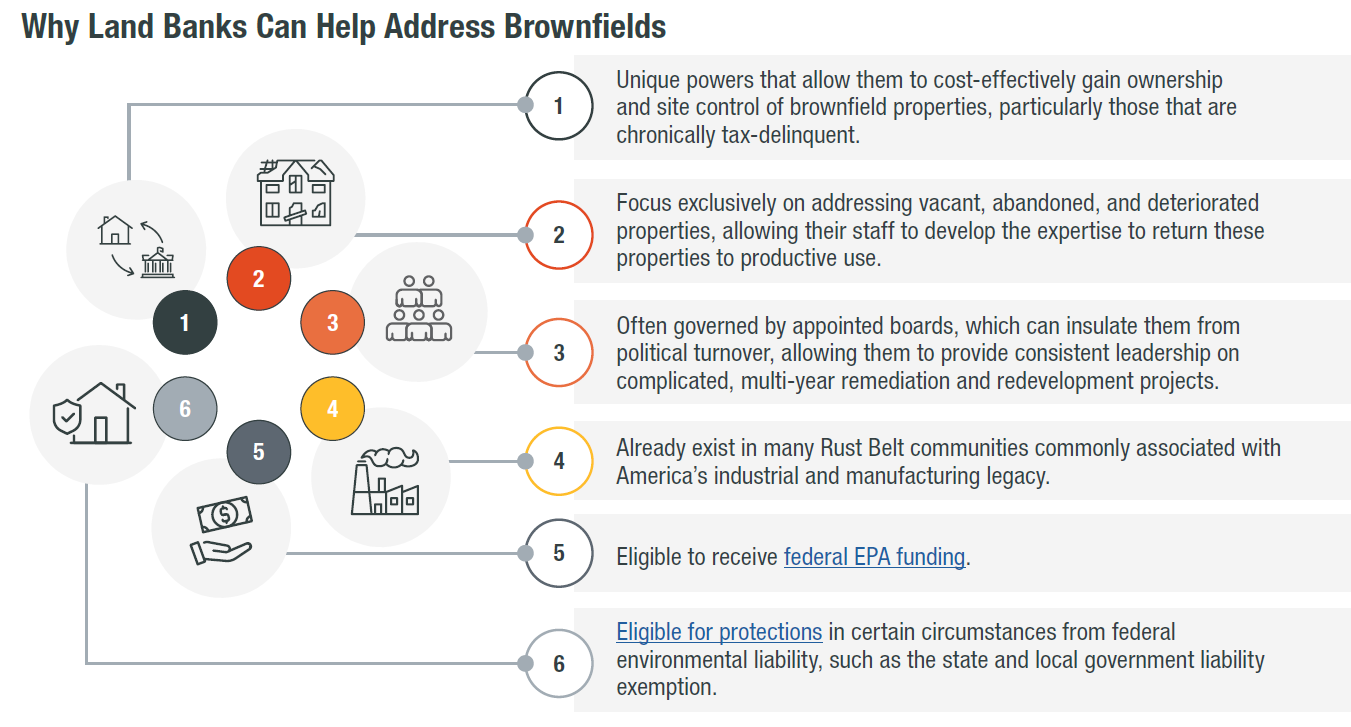
Some land banks might participate solely in helping a brownfield property through the assessment process. Others might leverage state and federal funds to do remediation. Still other land banks might assess and hold on to a brownfield property until a developer with an appropriate community-aligned plan for reuse of the property comes along. The key is for each land bank to find a role that leverages its powers effectively to fill a gap in the local ecosystem of brownfield remediation and reuse.
Looking to go deeper on land banks and brownfield remediation? Check out the following resources:
- Land Banks & Brownfield Redevelopment: Step by Step
- Emerging Practices & Practical Considerations for Land Banks & Brownfield Redevelopment
- 2027 National Brownfields Conferece: Call for Ideas (Session Proposals) is open through May 31, 2026.
Subscribe to join 14,000 community development leaders getting the latest resources from top experts on vacant property revitalization.